The road cannot be modelled away.
DfI Roads sought more information on how HGVs use the access; the applicant’s transport consultant argued that additional widening should not be necessary.
The Transport Assessment forecasts 26 HGV movements per weekday — 13 arrivals and 13 departures — plus about 10 staff-car movements. Its traffic percentage argument is only part of the planning question.
DfI’s August 2026 request
DfI Roads said the submitted drawing still required further information, including HGV auto-tracking to show entering and leaving movements and an engineering drawing providing a minimum 5.5m carriageway width along the applicant’s ownership frontage to help alleviate congestion.
DfI did not require that every metre of the northern rural approach be widened to 5.5m in that letter. But the broader approach route remains a legitimate question where routine HGV access is proposed.
↗ DfI Roads · 13 Aug 2026MRA's response: why widen for an assumed minority route?
In September 2026 MRA Partnership argued that most lorries would approach from Upper Newtownards Road, with relatively few arriving from the rural direction. It described additional widening as disproportionate to the anticipated traffic uplift, and raised the environmental impact of removing seven trees near No. 28.
Traffic uplift of around 2.4% is portrayed as small, with the majority of HGVs expected from the main-road direction.
↗ MRA’s September responseWhat controls or reliable evidence would justify reliance on that routing pattern, especially when an alternative rural approach remains available?
↗ DfI’s requested informationAny routing plan must be technically justified and practically capable of implementation. It is not correct to assume all traffic will automatically use one preferred route; nor is it proven that most HGVs will divert through the rural approach.
Tree loss: the applicant's own ecology report is clear
The preliminary ecological appraisal says that a long section of hedgerow would be removed for improved visibility splays and refers to ash, sycamore and hawthorn planting. It proposes replacement vegetation set back from the road.
MRA cites tree loss in resisting additional widening. The two proposals may involve different groups of trees and different transport benefits — but the applicant has already acknowledged that the main access works require substantial hedgerow removal.
↗ Ecological appraisal · §6.6 · ↗ MRA letter · p. 2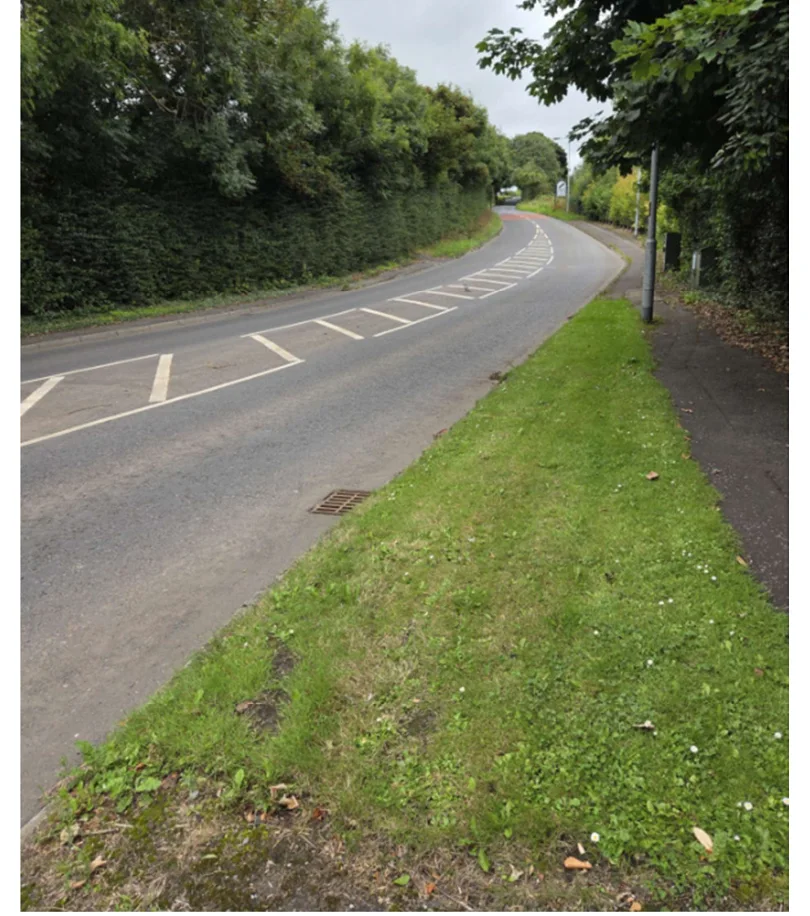
Full access arrangement
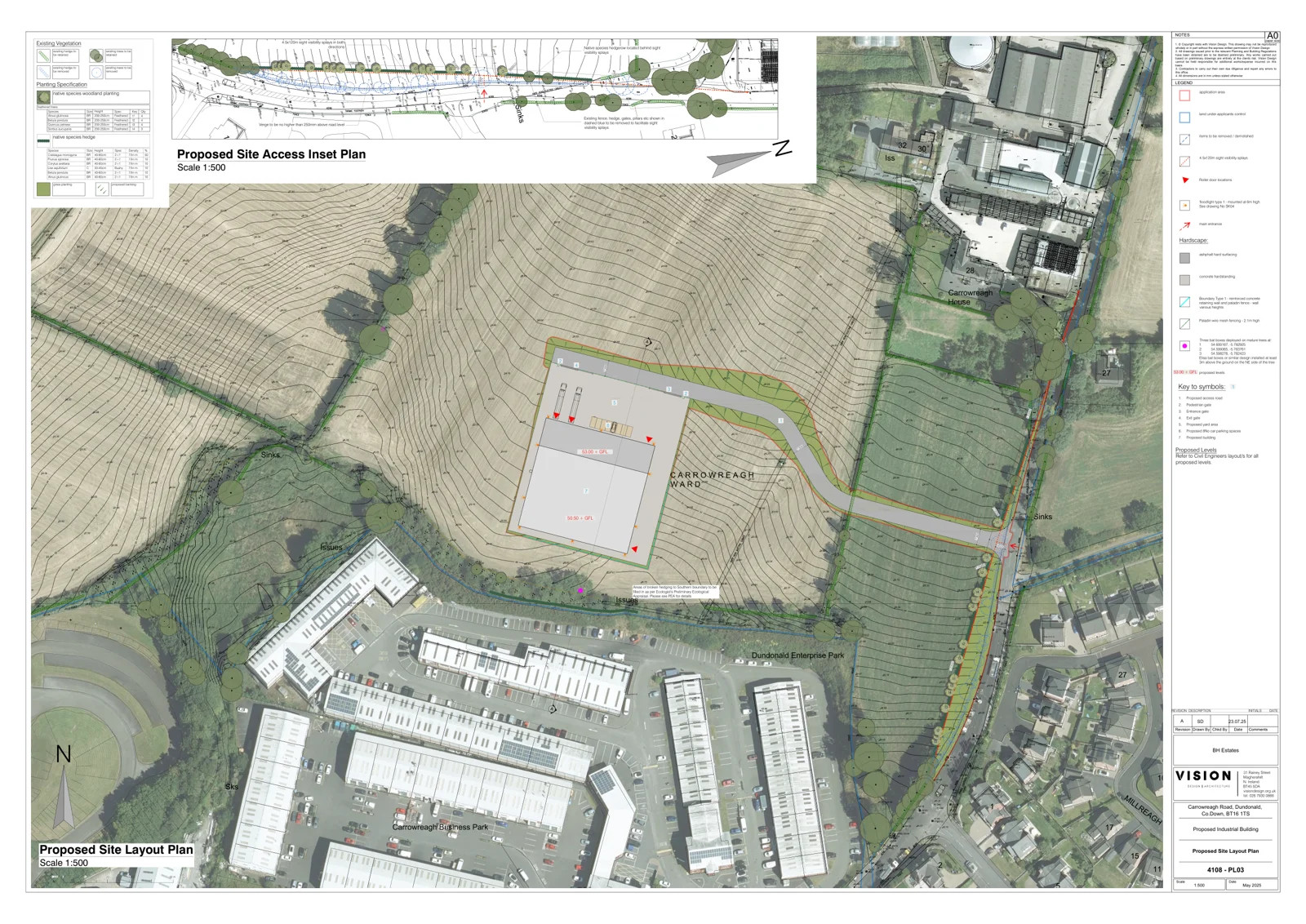
↗ Access run-off arrangements · ↗ Full applicant plan
The relevant planning question
Can the existing road network and necessary developer-led works safely handle the operational vehicles without an unacceptable impact on local amenity, junction operation, trees or other users? Policy ED9 requires the decision-maker to be satisfied on precisely those matters.
The question is compatibility, not simply zoning.
Read the statutory tests and examine the actual application documents for yourself.
Read the policy tests ↗ Browse documents ↗