The ammonia question.
What the applicant proposes to emit, what its model predicts, what DAERA asked for — and what ammonia can mean for residents, businesses and the natural environment.
What would actually leave the building?
The applicant proposes internal capture and treatment of process air, followed by release through a stack. Understanding the control system is essential to assessing its effectiveness.
All figures are taken from the applicant's original Air Quality Impact Assessment (AQIA), pp. 14–15. These are assessment inputs, not measured ambient concentrations at homes.
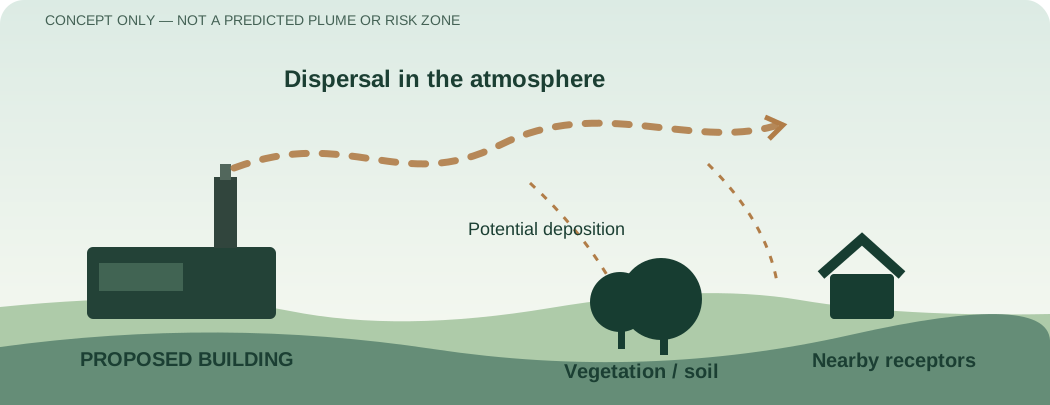
Illustration of general atmospheric pathways only. It does not depict actual wind direction, plume size, concentrations or a danger zone for Carrowreagh Road.
Local exhaust ventilation
Air would be extracted from inside the building, which is proposed to handle and process digestate and mineral additives. The proportion of emissions captured in practice matters.
UV treatment & carbon
The applicant describes UV treatment followed by carbon filtration. Modelling relies on quoted outlet concentrations; maintenance, performance and operating conditions must support those assumptions.
A single extract stack
The model uses a 16.9m stack, 0.51m tip diameter and 40°C exhaust. These determine predicted dispersion along with weather, topography and other inputs.
What is ammonia, and why does it matter?
Ammonia (NH₃) is a colourless, reactive gas naturally associated with the breakdown of organic nitrogen-bearing matter. Agricultural activities account for much of Northern Ireland’s emissions. In the atmosphere, ammonia can contribute to nitrogen deposition, affecting sensitive plants and habitats.
An emission is not necessarily an odour incident.
Ammonia can have a noticeable pungent smell. But the facility's overall odour emissions may include other substances. Odour impact and ammonia concentration must be evaluated separately.
Effects depend on concentration and exposure.
UK Health Security Agency guidance says ammonia can irritate eyes, nose and throat; high exposures can cause more serious injury. It also says typical low environmental exposure is not expected to pose a human-health risk. No harmful ammonia concentration at nearby homes has been demonstrated by these documents.
↗ UKHSA ammonia guidanceNitrogen deposition can harm sensitive habitats.
DAERA explains that ammonia may deposit onto soils, vegetation and water, contributing to nitrogen loading. This can alter sensitive habitats even when an individual source contributes relatively little.
↗ DAERA ammonia overviewWhat does the applicant's modelling predict?
The original assessment calculates low annual-average ammonia process contributions at assessed residential and ecological receptors and considers relevant impacts below the assessment thresholds it uses. That is part of the record and must be acknowledged.
Its modelling is, however, built around specified stack inputs, abatement performance, assumed production conditions and defined emission sources. The reliability of the outcome depends on whether those inputs accurately describe the complete operation.
The modelled emissions, after treatment and dispersion, are predicted to have low or negligible effects at the assessed receptors.
↗ AQIA receptor results, pp. 23–26DAERA Natural Environment Division asked for revised emissions modelling and further evidence covering process stages, possible fugitive releases and manufacturer specifications for controls.
↗ NIEA / NED consultation responseWhere could emissions escape without passing through the stack?
This is one of the most important technical questions. The proposed scheme includes deliveries, unloading, handling, mixing, drying or conditioning, pelletising, storage and vehicle activity. These may not all be captured to the same degree by a Local Exhaust Ventilation system.
We are not saying that such releases will necessarily occur at harmful levels. We are asking for evidence explaining which process stages have been assessed, how doors and vehicle movements are treated, and what happens if capture or filtration performs below the assumed level.
- Which emission sources and processing stages are included in the dispersion model, and which are excluded?
- What evidence supports the modelled outlet ammonia concentration of 2.2 mg/Nm³?
- Are loading, unloading, door opening and filter performance changes included in reasonable operating scenarios?
- Are all assumptions about stack temperature, airflow and abatement reconciled with the engineering design?
- How were sensitive ecological receptors and background nitrogen deposition evaluated?
- Would enforceable conditions ensure the operational controls match the tested scenario?
Two figures that should be reconciled
The AQIA’s Table 8 states 3,700 ou/s but accompanying text says 3,600 ou/s was modelled. Which input was used?
↗ AQIA p. 14Table 17 reports 0.120 at receptor E1 while accompanying commentary says 0.012 kg N/ha/year. The two values differ tenfold in the printed narrative.
↗ AQIA p. 25Such discrepancies may be typographical and do not establish that the dispersion model itself is wrong. The appropriate next step is a documented reconciliation of the calculations and figures.
What DAERA says about the wider issue
DAERA identifies ammonia and reactive nitrogen as important pressures on Northern Ireland's habitats. Its official guidance explains how nitrogen deposition can affect protected vegetation and that planning assessments should account for potential impacts.
That broader environmental concern is not a finding that this individual proposal would breach a critical load. The question is whether this application's site-specific assessment is complete and robust.
↗ DAERA: Effects of air pollution on natural ecosystems
See the model. See the questions.
Every material figure used on this page comes from the applicant's submitted AQIA or official public health/environmental guidance.
Open applicant's AQIA ↗ Open DAERA response ↗