A 24-hour industrial operation. Close to home.
A proposed digestate-and-fertiliser production facility beside Dundonald's established homes and business parks. The question isn't whether sustainable agriculture matters. It's whether this is the right place for this industrial use.
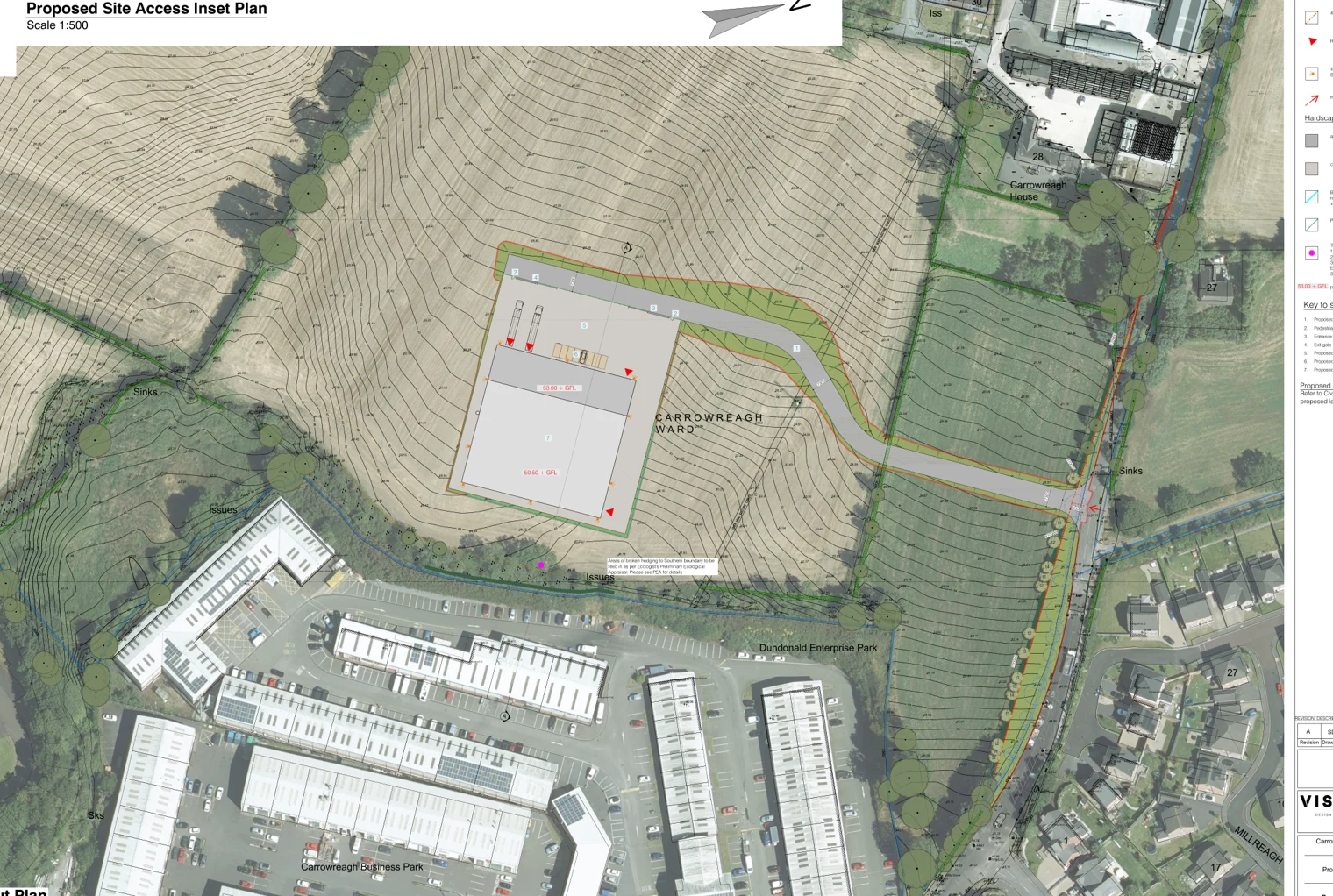
Read the evidence behind the headlines.
Two detailed investigations, built from the original planning material and an official Assembly clarification.
No endorsement. No opposition. No Committee position.
What the Assembly Committee actually said after a supporting representation suggested it backed the plans.
See the evidence and letter ↗ AIR QUALITY · AMMONIA · NITROGENWhat does the exhaust assessment really show?
The treatment system, the modelling assumptions, possible effects and the regulator's questions.
Explore the technical evidence ↗Employment land is not a blank cheque.
The adopted planning policies require compatibility with existing uses. The evidence needs to show this particular B3 operation is acceptable in this particular location.
Compatible with nearby uses?
General industrial development on zoned land must still be compatible with adjacent uses and appropriate in scale, nature and form.
↗ Economic Development · LCCC adopted policy, p. 44What about existing jobs?
Planning policy protects economic activities where incompatible development would prejudice existing operations, particularly clean-environment uses.
↗ Protecting existing enterprises · LCCC adopted policy, p. 49Can impacts be controlled?
Residential amenity, noise, emissions, water protection, road safety and building design all face additional policy tests.
↗ General development criteria · LCCC adopted policy, p. 49Look beyond the headline.
Each section makes specific claims, links to the original record and acknowledges what the applicant says in response.
Homes & businesses.
What compatibility means when families and food production operate close to the proposed site.
Explore the case ↗Noise, odour & night-time.
What Environmental Health asked about roller doors, modelling assumptions and fugitive emissions.
Explore the case ↗Ammonia & exhaust.
Understand DAERA's technical requests and the distinction between flood drainage and pollution control.
Explore the case ↗HGVs & rural roads.
26 modelled daily HGV movements, a constrained approach and a live debate about extra widening.
Explore the case ↗Landscape & visual scale.
See the applicant’s before/after photomontages, slope, new access and the effect of lighting.
Explore the case ↗What must Planning decide?
Read the adopted policies and see which tests matter most in this application.
Explore the case ↗Official consultees asked for answers.
The reports submitted by the applicant predict low impacts under their assumptions. But some consultees requested more information before accepting those assessments.
Environmental Health
Requested more information on noise, fugitive odour, abatement assumptions and external lighting.
↗ Read the Council responseDAERA / NIEA
Requested more detail on process emissions, ammonia, water protection and digestate handling.
↗ Read the DAERA responseDfI Roads
Still sought HGV auto-tracking and a revised frontage-width engineering drawing.
↗ Read the Roads responseThese responses record the position on their stated dates. Check the official Planning Register for subsequently submitted information and consultation conclusions.
A neighbouring employer has objected.
A nearby food manufacturer submitted a detailed objection describing its production schedule, local economic contribution and concerns about odour, food-safety confidence, staff and customer impacts.
Those are stated business concerns — not proof that harm will occur. But they raise a direct question under Policy ED8 about protecting established employment.
↗ Read the neighbouring food producer’s letter
See why this matters ↗Read both sides. Ask the harder questions.
We distinguish predictions, regulator requests, and documented conclusions instead of treating every concern as proven damage.
Its air-quality and noise consultants forecast low or negligible effects when specified controls and assumptions apply.
↗ See air-quality modelling↗ See noise modelling
Environmental Health and DAERA asked for additional information about the model assumptions, real processes and sources of emissions.
↗ Environmental Health↗ DAERA
This isn't opposition to sustainable agriculture. It's a demand that industrial development demonstrably fits the people, businesses and environment already here.
Examine the complete file ↗How did we get here?
From the original June 2025 submission to technical responses and the September 2026 Roads dispute.
Application lodged
Class B3 building, new access and associated industrial processing proposals submitted.
Technical questions
DAERA, Environmental Health and Shared Environmental Service sought further information.
The roads debate
DfI requested further information; MRA challenged additional road widening.